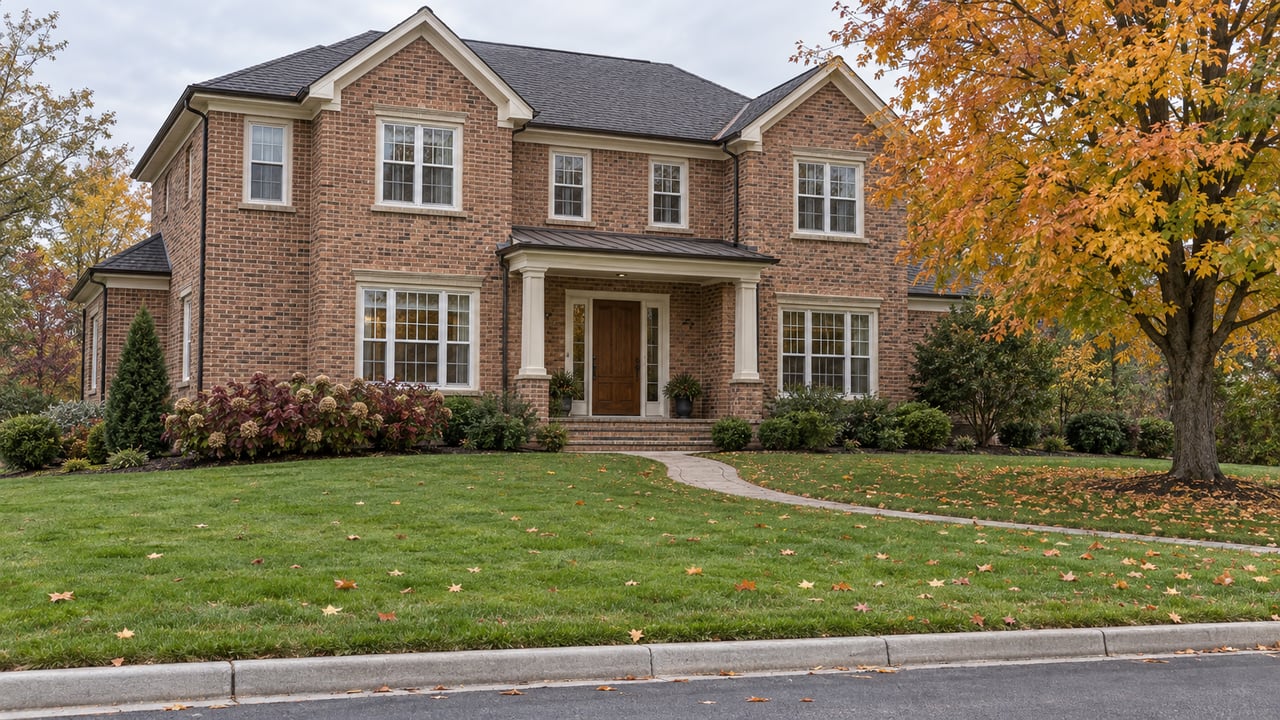
A buyer goes under contract on a Tudor near Market Avenue North, the kind of house with a deep front lawn, a turret, and a driveway that curves in from the street the way houses were built when land was still cheap and craftsmanship was the selling point. The home inspection comes back clean enough. A few maintenance items, nothing that kills the deal. The appraisal clears. Everyone exhales.
Then the insurance agent calls with a question nobody thought to ask earlier: what kind of wiring does this house have.
That single question, asked at week three or four of a typical Ohio closing timeline, is where a lot of Canton historic-home purchases hit unexpected friction. Not from the inspector. From the underwriter.
The Wiring Nobody Flags Until Someone's Trying to Insure It
Knob-and-tube wiring was the standard method of running electricity through American homes from the 1880s into the 1940s. It uses ceramic knobs to hold wires away from framing and ceramic tubes to route them through joists and studs, with no ground wire and no way for a stray current to discharge safely. It was good technology for its era, when a house might run a few lamps and a radio. It was never built for central air, a dishwasher, and a house full of chargers running at once.
Canton's own historic housing stock sits almost exactly inside the years this wiring was common. Historic Ridgewood, the neighborhood of brick streets and Revival-style homes east and west of Market Avenue North, was platted starting in 1918 and built out mostly between 1920 and the start of the Depression, according to the district's National Register of Historic Places documentation from 1982. The homes were designed by local architects who left their mark well beyond Ridgewood. Charles Firestone, who also designed Timken High School, Fawcett Stadium, and the Canton Memorial Civic Center, drew a dozen of the district's buildings. Herman Albrecht and Louis Hoicowitz, working out of Canton and Massillon, designed dozens more, favoring turrets and storybook detail that still draw people down those streets for a slow drive on a Sunday.
The same era shows up across several other Canton neighborhoods built out in overlapping decades. Colonial Heights carries homes from the 1920s through the 1950s. Market Heights spans the early 1900s into the 1950s. Vassar Park's housing dates to the early 20th century as well. None of these are obscure pockets. They are some of the most walkable, most character-driven blocks in the city, and they are also, almost by definition, the blocks most likely to still be running on the wiring their original owners had installed.
Why the Inspection Doesn't Catch What the Insurance Application Does
Here's the part that trips people up. According to Insure.com, knob-and-tube wiring is not illegal, and no code requires an owner to remove it. Plenty of inspection reports simply note the wiring type as an observation and move on, especially if it appears confined to an attic or a single older section of the house.
Insurance underwriting works differently, and on a different clock. Most standard carriers will not write a new homeowners policy on a house with active knob-and-tube wiring, full stop, regardless of how the rest of the house looks. That's a underwriting decision made off the wiring type alone, not off whether an inspector called it urgent. And because insurance applications often don't get fully underwritten until later in the file, after the purchase agreement is signed and sometimes after the appraisal, the wiring question can surface well past the point where a buyer still had leverage to negotiate price or ask for repairs as a contingency.
That timing gap is the real risk in these neighborhoods. Not the wiring itself, which a licensed electrician can document and price. The risk is discovering it at the moment you have the least room to do anything about it.
What the Coverage Options Actually Look Like
Once a Canton home is flagged for active knob-and-tube, buyers and sellers are usually choosing among a short list of paths, and they carry very different costs and timelines.
| Path | What it involves | Rough cost picture |
|---|---|---|
| Standard carrier | Typically declines to write a new policy on active knob-and-tube | Not available in most cases |
| Specialty or surplus-lines carrier | Will write a policy, often with a rewire deadline attached | Premiums commonly run 2 to 3 times a standard rate, with deductibles in the $2,500 to $5,000 range and a rewire window of roughly 6 to 12 months |
| Ohio FAIR Plan | The state's insurer of last resort | According to Still Insurable, Ohio's plan writes a true open-peril HO-0003 form, broader than most states' FAIR plans, but pricing and terms are narrower than the standard market. The current Plan of Operation took effect April 1, 2025 |
| Full rewire | Permanent fix that reopens the standard insurance market | Reopens standard-rate shopping once a licensed electrician's completion documentation is on file |
Every one of these paths still requires the same starting point: a licensed electrician who can say, in writing, how much of the house is actually still live knob-and-tube versus how much was already updated during a past remodel. That distinction matters, because a house with a few old circuits feeding an attic is a very different underwriting conversation than a house running entirely on its original 1920s wiring.
What This Means If You're Buying or Selling in One of These Neighborhoods
If you're selling a pre-1950s home in Ridgewood, Colonial Heights, Market Heights, or Vassar Park, get ahead of the question rather than waiting for a buyer's insurance agent to raise it. A written report from a licensed local electrician, the kind of documentation a company like Gragg Electrical Services provides for Canton-area homes, tells a buyer exactly how much of the house is still original wiring and what a rewire would realistically cost. That report becomes a negotiating tool instead of a last-minute scramble, and it lets you set expectations in the listing rather than mid-contract.
If you're buying one of these homes, call your insurance agent the same week you go under contract, not after your inspection period closes. Ask directly whether the home has knob-and-tube wiring and, if so, whether it's confined to one area or runs through the whole house. That answer determines whether you're looking at a standard policy, a specialty carrier with a rewire deadline, or a FAIR Plan bridge while a rewire gets scheduled. Knowing which of those three you're dealing with in week one is a very different position than finding out in week five.
Frequently Asked Questions
Is it illegal to have knob-and-tube wiring in a Canton home? No. There's no law requiring removal. The obstacle is almost entirely on the insurance side, where most standard carriers decline to write new policies on homes with active knob-and-tube regardless of the wiring's condition.
If the home inspector doesn't flag it as a defect, does that mean insurance won't be a problem? Not necessarily. A home inspector's job is to describe the condition of the house, not to underwrite an insurance policy. The two processes run on different standards and often on different timelines, which is exactly why the insurance question can surface after the inspection period has already closed.
Does every older Canton neighborhood carry the same level of risk? Not evenly. Homes built later in this era, especially into the 1950s, are more likely to have been partially or fully rewired at some point, and a licensed electrician's inspection is the only reliable way to know where a specific house stands.
If you're weighing whether to list a historic Canton home this fall, or you've found one you love and want a clear-eyed read on what you're walking into, Casey Roch and the team at RE/MAX Infinity know these streets and this housing stock well enough to help you ask the right questions early. Start with a free home valuation and a conversation about what your specific address might be carrying behind the walls.
This article is general information, not legal, tax or financial advice. Consult a qualified professional about your situation.